

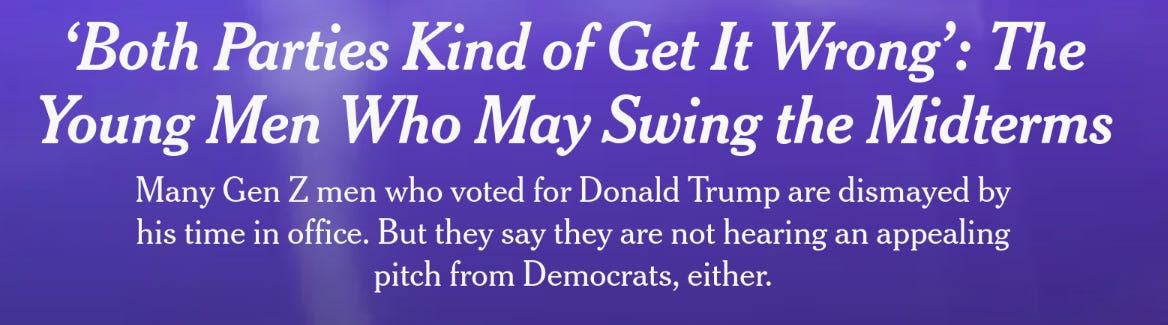
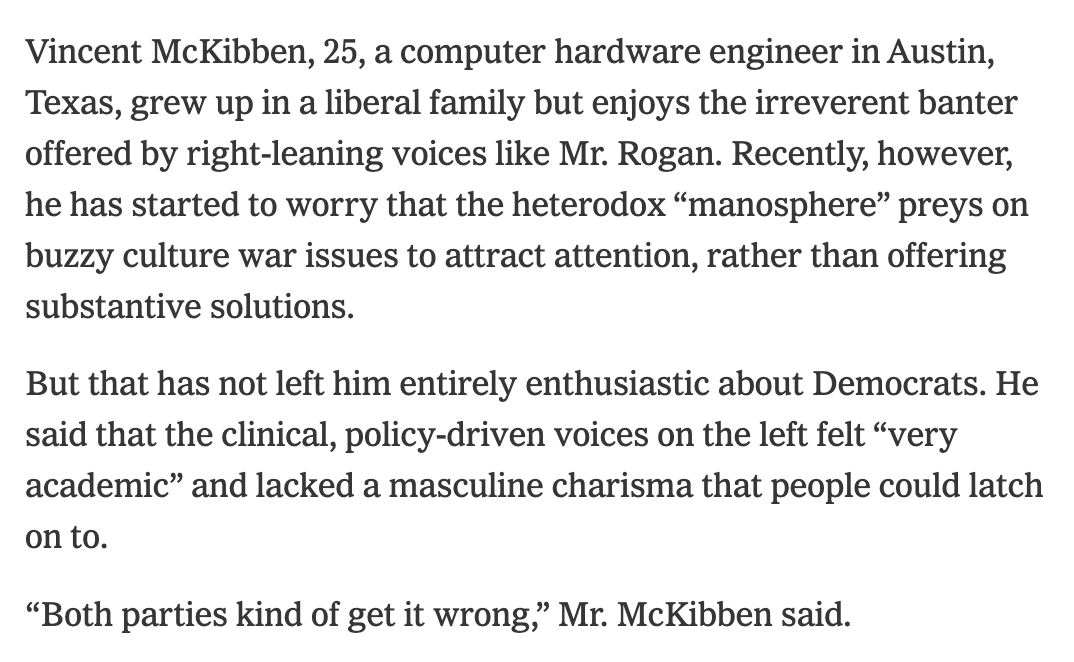
So, I made it into the New York Times and as the headline quote!
How it Happened
In March 2025, a couple months into moving to Austin, I attended NatalCon, a conference on Pronatalism. The conference was awash with journalists seeking to get a glimpse at the types of people who would attend such a conference. There I met Emma Goldberg, a reporter at the New York Times. I did one interview with her and another with someone at The Daily.
They didn’t end up using my comments and instead wrote an article about the women at NatalCon, but Emma and I did exchange contacts at the conference. Many months later, in October, I get a text from Emma asking about scheduling another interview related to some of the things we discussed at NatalCon.
I did the interview in two parts, one over the phone and another where Emma visited me in Austin for an in-person interview. It was pitched to me as discussing the issues of young men. I had no clue when the article would come out. The editorial process for these things takes forever if it’s not a timely news story. Originally they said it was gonna be a culture article and then later on they decided it should be a politics story. They even called me to ask about my voting record because of this change.
Ultimately I found out that the article was published from a friend texting me this Thursday night:

The Surreal
The interviews were probably around 2 hours of content, so I was really curious how they edited the article together. I get home, read the article and recognize why they moved it to a politics story, to frame it around the midterm elections and young men as “swing voters.” The majority of the article follows these young men at Carroll University in Waukesha, Wisconsin (note Wisconsin is a swing state). So I get the article’s framing and I’m one voice in a sea of many.
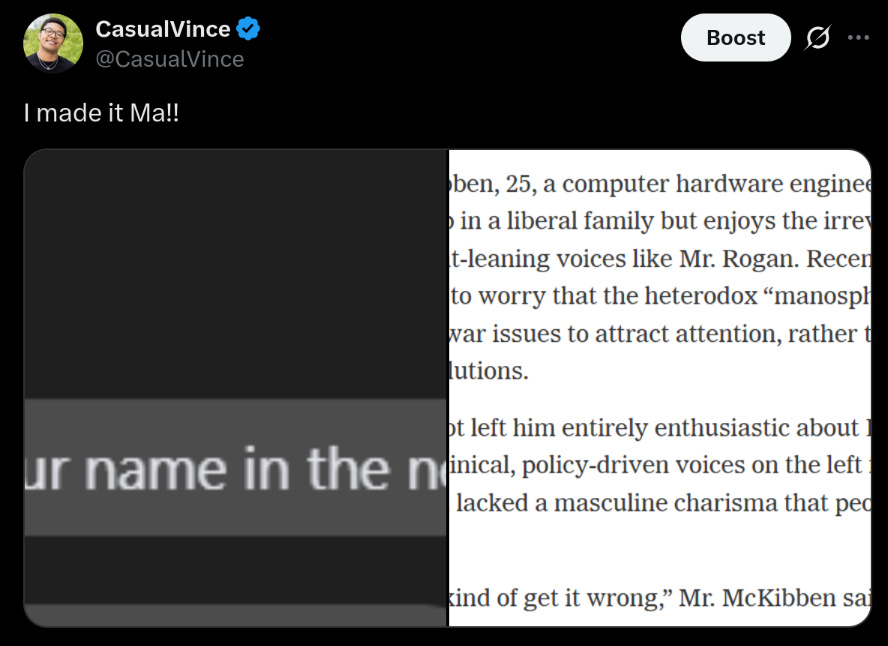
So I go to Twitter and make a small post about being in the NYT saying “I made it Ma!!” and linking the article. I text my friends and family and they’re all happy for me and I go on to bed.
But then, I wake up the next morning and little do I know many people also saw my section of the article, and they were talking about it well before I even saw the article myself.
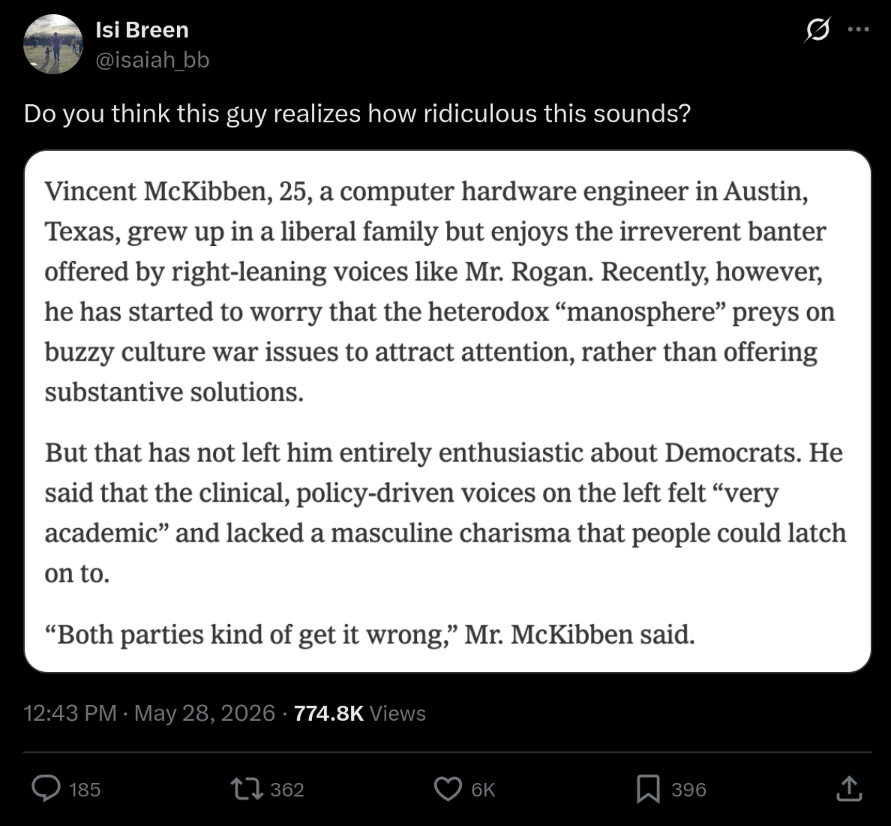
I only knew about this post from someone in the replies to mine:
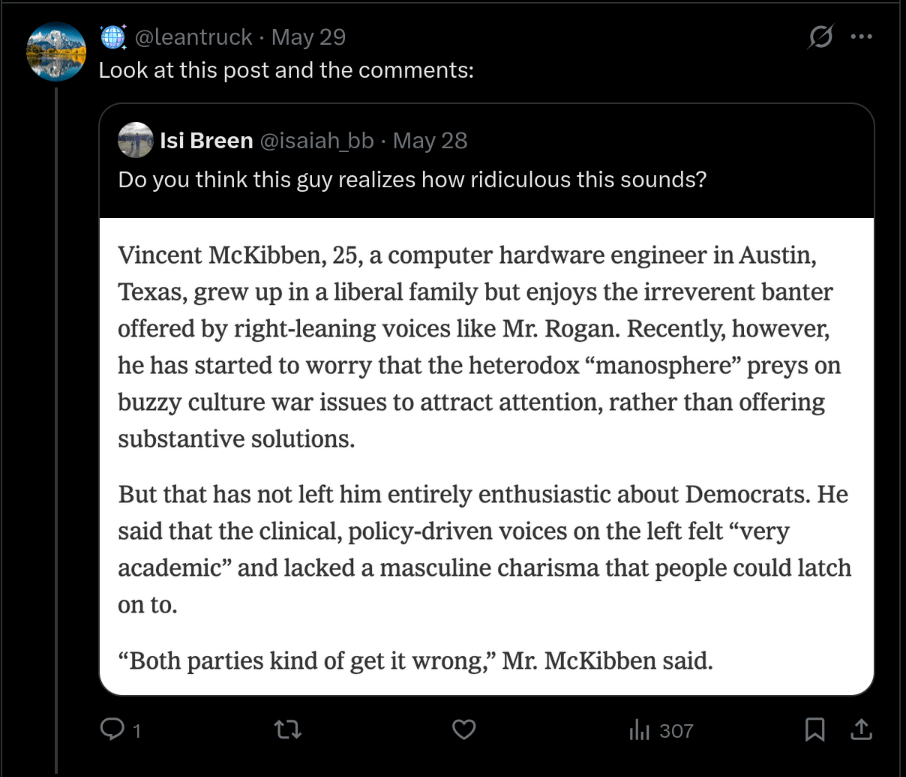
When I saw the Isi post Friday morning, it already had 500k views and then there were other posts on BlueSky as well. The comments and quotes are all over the place. I didn’t spend too much time in the comments before making my response(s). It was pretty clear that people were making massive assumptions about me from the paraphrase alone.
Without much context it’s very easy to read this section and go “oh this is another dipshit MAGA white guy.” The broader article doesn’t help this at all because every single picture is of white people.
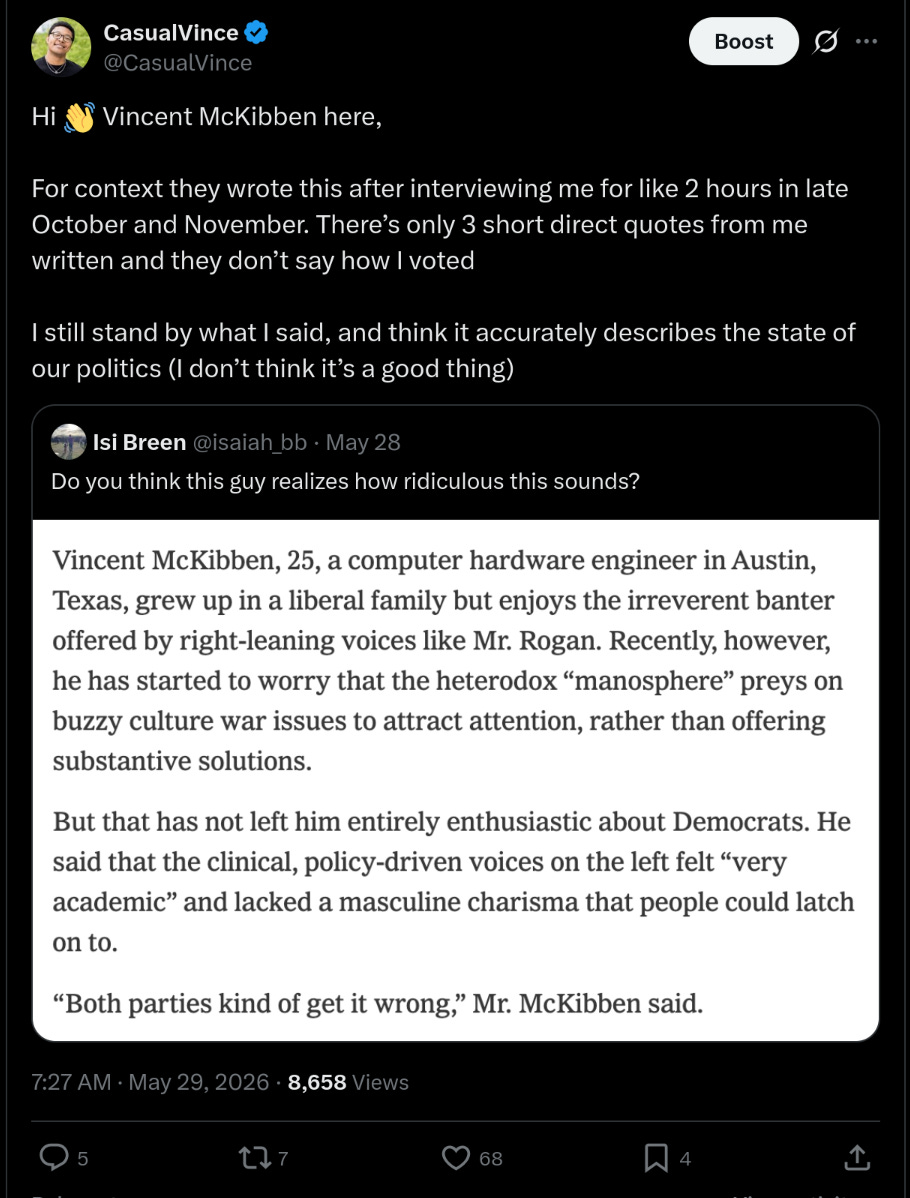
It’s really surreal to think about. Here’s a screenshot with my name in it, divorced from the original article, and a bunch of people have been sitting online talking about me without my knowledge for hours.
No Big Deal
After making my response, I didn’t post or reply for the rest of the day. I had already missed much of the viral opportunity I would’ve gained anyway. The original post was up for over 8 hours before I even knew the article existed. I also truly try not to talk about my politics too much publicly outside of housing, public transit, and energy. I think writing this essay almost a year ago prepared me well for “the hate” honestly
In my personal life, I’ve been thinking a lot about this: to what extent do I be authentically me? Because authentic me will be polarizing. I’m like a flavor of ice cream, let’s say chocolate. Some people love chocolate ice cream, most people are indifferent to it, and some people hate it. I could live my life as some “flavor shape-shifter” being vanilla one day, strawberry another, and for very few allowing my true chocolate self to show. But why do I even want the vanilla and strawberry people in my life? I should just be chocolate and see where the chips fall, just be authentic.
I’m thinking about social media and writing in the same vein. The primary difference is the scale. In real life, if someone doesn’t like you, (most likely) you never have to see them again (exception being someone in your family, workplace, or school). In online life, you can get people who actively dislike you. The closest real world analogy is a bully, who will always try to get on your nerves in your presence. Although online you can mute or block the bully, at a certain scale you have to just ignore it because of the sheer volume. At that scale, you’re in this strange reality where people, without even knowing you, utterly hate you. And that’s such a mind fuck.
It was a really great example of Twitter and the internet being a completely parallel reality to my daily life. In all likelihood, if I had never posted, I wouldn’t even know the “hate mob” existed at all. My day-to-day life was functionally unchanged by this article publishing.
All my friends and family who saw it were excited and happy for me, and were either positive on my section or thought it was just pretty milquetoast. I surprised myself with how lax I was about it too, I had friends come to me and say “so how’s it feel to be the main character of the internet?” I was far more focused on 1) whatever I talked about in therapy that morning and 2) preparing for a game night I was hosting that evening. The extent to which buzz on Twitter and Bluesky crossed my mind was surprisingly little if not prompted (I keep non-DM notifications off on every app).
It feels pretty good to have properly internalized “these people don’t know you, so their opinions of you don’t matter.” This was also such a clear example of “they don’t know you and they don’t care to know you.” Because my full name is on the article, it is very easy to Google me and you’d see that I’m clearly not white. You might not know what a Blasian looks like, but you’d definitely think “oh, that’s some kind of black man.”
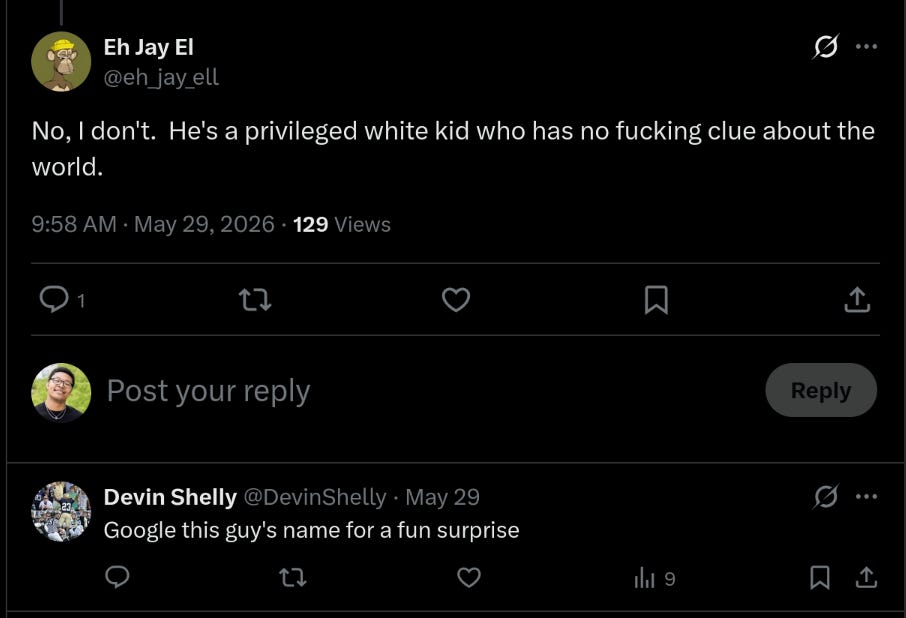
(Note: It looks like some people have actually done this after I responded, seems like the “white man” posts have been largely deleted, go figure)
I polled some of my friends for fun on this, asking them if without context they would think I was a white man and how they thought I voted:
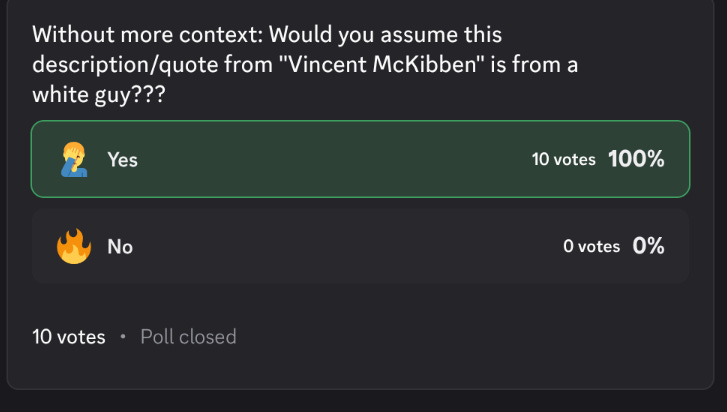
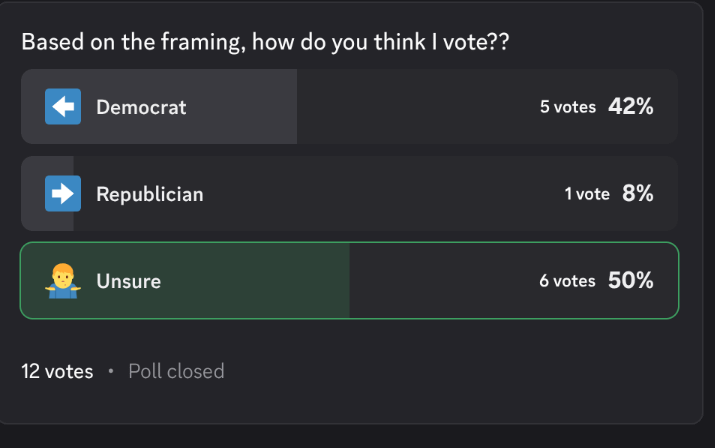
Thoughts on the Framing
So what do I think of what the NYT actually ended up writing? Well, I recorded the first over-the-phone interview (I said I would). Listening back, the interview isn’t the best on my part, it’s honestly pretty rambly and all over the place. The headline quote “Both parties kinda get it wrong” is from the in-person half, I don’t have the recording of that.
Reading my portion of the article though, it largely reflects what I said in the first interview. I can understand why my words are framed as they are. They overemphasize my listening to/watching “manosphere” content and downplay any affinity I may have for the Democratic Party. I don’t think anything they wrote was factually untrue. They did a decent job of taking my rambles and making them succinct. It honestly shows in the recording that it’s half a year ago. I don’t sound particularly firm on my positions listening to the interview, so the framing matches the energy that I gave them more than I initially thought.
There are only two legitimate gripes I have with their framing. They say “recently” when referring to my issues with the manosphere, which makes it seem like it only dawned on me during Trump 2.0. That isn’t accurate. Also my focus was largely on the center-left when I was referring to the academic nature of Democrats. From the recording, I explicitly say center-left and refer to figures like Richard Reeves and Scott Galloway.
Like I said earlier, I did tell them my voting record. I said they were free to say who I voted for in 2024, they chose not to publish it. If you read the article, the only time voting habits are mentioned is when the interviewees voted for Trump. Here’s some more context about things I said in the interview and I’ll let the audience decide whatever they wanna hear (they do that anyways). These are some of the things I was willing to have published anyway so no big deal saying now:
I was born and raised in Chicago to a very progressive family, my mom is Chinese and my dad is Black American, I’m the youngest of four kids
OG Weeb, went to anime conventions as a kid
Watched RuPaul’s Drag Race growing up
Still some traditional values, owing to my parents being Baptist Christians
I was in a gay-straight alliance in middle school and a feminist group in freshman year of high school
After Trump’s election in 2016 I started listening to whatever right-leaning content I could find because it broke my priors on how I thought America worked
Podcasts I mentioned in the interview: Joe Rogan, Jordan Peterson, Ben Shapiro, Tim Pool
I was aware of “Gamergate” as it was happening
After Dobbs (2022), it was clear that the right-leaning pundits that were getting people into their movement via “anti-wokeness” were actually more conservative than they’d let on
I first discovered the manosphere from a Quora post when I was in high school. There was some YouTube channel mentioned in the comments of a post I was reading. I consider the mainstreamization of the manosphere to be from figures like Andrew Tate and now Clavicular, it’s largely more shallow than the original PUA and OG red pill stuff
I had my “conspiracy” phase in 2020-2021 with the covid lockdowns, pretty much broke by the time Jan 6 happened in 2021 (note I was 19 years old when this happened)
A large amount of my volunteer time and political advocacy is on housing and “urbanist” issues, you can see that I’ve testified in Denver and the Texas Capitol and City Hall in Austin on such issues.
Looking back at the interview, I totally get why they didn’t emphasize any left-leaning aspects of my views lol. Because I didn’t emphasize it enough myself. It genuinely sounds like I just drifted right-ward from “the podcast bros” then never came back. So yeah, their framing is more apt than I initially gave it credit for. Again, I’m actually not too public about my politics so the interview is a reflection of that same tepidness to declare it. I’m much more open about it in private though.